Fares Souissi
Growth & Acquisition Marketer | Data & AutomationBuilding Autonomous Growth Operations with n8n and Claude AI Agents
How modern scale-ups deploy growth automation with production-grade n8n pipelines and intelligent Claude AI agents for zero-touch lead qualification, ad anomaly detection, and CRM synchronization.

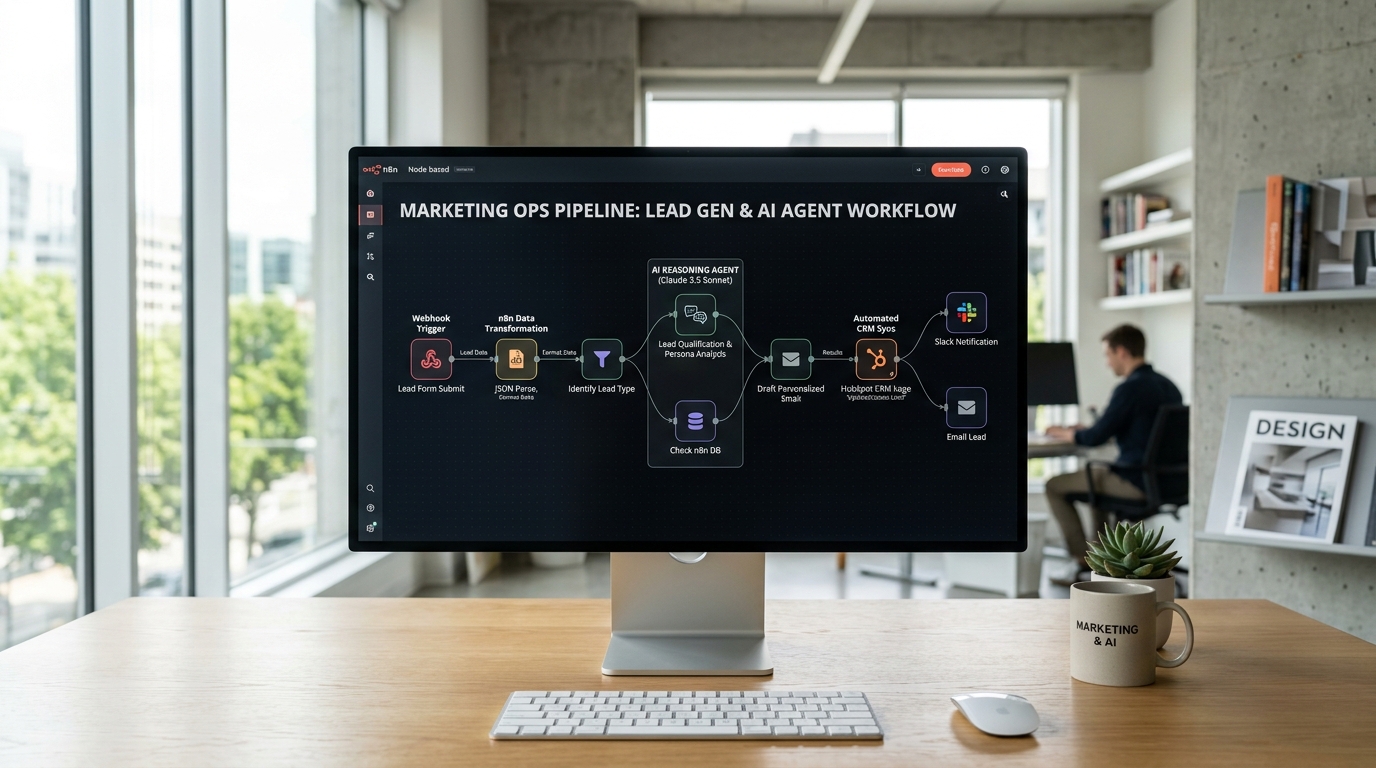
Table of Contents
- 1. Moving Beyond Zapier: The Growth Automation Imperative
- 2. Production n8n Architecture with Claude AI Integration
- 3. Zero-Touch Lead Qualification & Intent Scoring Engine
- 4. Automated First-Party CRM Enrichment & Bid Signal Sync
- 5. Creative Performance Monitoring & Automated Slack Alerts
- 6. Security, Webhook Reliability & Self-Hosted Infrastructure
- 7. Conclusion: Engineering an Autonomous Growth Automation Engine
1. Moving Beyond Zapier: The Growth Automation Imperative
As digital acquisition scales, the operational friction of manual growth management compounds exponentially. High-velocity marketing teams find themselves bogged down in repetitive manual tasks: downloading CSV reports, enriching inbound lead forms, categorizing CRM pipeline stages, and monitoring ad accounts for spend anomalies.
Traditional no-code tools like Zapier handle linear triggers adequately for early-stage MVPs. However, they quickly become cost-prohibitive and fragile when workflows require advanced conditional logic, unstructured data reasoning, batch payload handling, and high-frequency webhook execution. When high-volume leads arrive with ambiguous company titles or partial form data, linear zaps fail, forcing human operators to spend hours manually investigating accounts.
To establish durable competitive advantages, modern growth teams are turning to growth automation powered by self-hosted n8n workflow engines paired with LLM reasoning nodes from Anthropic Claude API. This paradigm shift transforms rigid deterministic scripts into adaptive, autonomous growth agents capable of understanding context, evaluating intent, and triggering automated actions in real time.
“AI agents do not merely move JSON payloads from point A to point B; they interpret, validate, and enrich business data before any human intervention is ever required.”
2. Production n8n Architecture with Claude AI Integration
An enterprise-ready growth automation infrastructure is built on modular, event-driven micro-services. By self-hosting n8n via Docker or Kubernetes on Google Cloud Run or AWS ECS, teams maintain complete sovereignty over their customer data while eliminating per-task SaaS subscription fees.
Here is the reference architecture for an end-to-end intelligent lead triage and enrichment pipeline:
This automated flow executes in under 850ms from form submission to CRM record creation, ensuring that high-intent prospects receive immediate engagement while your team focuses solely on high-leverage closing conversations.
| Automation Feature | Legacy SaaS (Zapier / Make) | Self-Hosted n8n + Claude AI |
|---|---|---|
| Pricing Model | Expensive per-task tiered pricing | Flat server hosting (~$15/mo) + Raw API tokens |
| Data Reasoning | Rigid text matching & regex rules | Dynamic LLM reasoning & semantic analysis |
| Data Sovereignty | Third-party vendor data transit | Full GDPR/CCPA compliance on private VPC |
| Execution Latency | Polling intervals (1-15 min delays) | Real-time instantaneous webhooks (<1 sec) |
3. Zero-Touch Lead Qualification & Intent Scoring Engine
Standard lead capture forms face an inevitable trade-off: asking for too many fields destroys form conversion rates, while asking for too few yields low-quality submissions. Intelligent growth automation solves this dilemma by keeping forms ultra-lean (Name, Work Email, Primary Goal) while offloading qualification to AI reasoning engines.
When an email is ingested, the n8n agent extracts the corporate domain, queries enrichment databases for employee count, funding stage, and technology stack, and feeds this contextual profile into Claude. Claude then analyzes open-ended responses against your Ideal Customer Profile (ICP) matrix:
- Technical Feasibility Check: Does the prospect’s tech stack support server-side tracking, GTM, or custom API integrations?
- Budget & Spend Qualification: Based on headcount and industry benchmarks, does the organization have sufficient ad volume to benefit from systematic creative testing?
- Sentiment & Urgency Scoring: Is the prospect facing an immediate tracking blackout or actively planning next quarter’s acquisition roadmap?
Discover how this automated qualification pipeline pairs with our proven ROAS optimization matrices to maximize marketing efficiency.
4. Automated First-Party CRM Enrichment & Bid Signal Sync
Lead data is only valuable if it circulates back into your primary ad algorithms to train machine learning bid models. In a modern growth stack, the n8n engine acts as a bidirectional bridge between your CRM (HubSpot, Salesforce, Pipedrive) and your ad platform Conversion APIs (Meta CAPI, Google Enhanced Conversions).
When a lead advances from Lead Created to Sales Qualified Opportunity (SQL) or Closed-Won Customer, n8n captures the webhook event, hashes first-party identifiers (SHA-256 email, phone number, and IP), and pushes the high-value conversion signal directly to ad platforms.
This closed-loop feedback trains Meta Advantage+ and Google Smart Bidding algorithms to optimize for actual revenue-generating customers rather than superficial top-of-funnel form fills. Learn more about clean event architecture in our server-side tracking guide.
Attribution Velocity
Closing the loop between CRM stage changes and Meta CAPI Offline Conversions within 60 minutes improves algorithmic bidding match rates by up to 34%, drastically lowering the acquisition cost of high-LTV customers.
5. Creative Performance Monitoring & Automated Slack Alerts
Scaling paid media across multiple channels without automated safeguards exposes budgets to overnight spending spikes and algorithmic runaway. Using scheduled n8n cron workers, our growth automation system queries ad account APIs every 2 hours to calculate real-time unit economics.
If any active ad set experiences:
- CPA exceeding 1.8× target threshold over 300+ impressions,
- Spend velocity accelerating beyond 150% of the daily pacing schedule, or
- Tracking discrepancies between platform conversions and server-side logs greater than 15%,
The n8n agent immediately posts an interactive alert to the team’s Slack channel with one-click pause buttons and diagnostic recommendations, preventing wasted ad spend before daily budgets are exhausted.
6. Security, Webhook Reliability & Self-Hosted Infrastructure
Enterprise growth automation requires production-grade reliability and strict security governance. Key engineering practices include:
- Idempotency Keys: Every incoming webhook is stamped with a unique SHA-256 hash stored in Redis with a 24-hour TTL, preventing duplicate event processing or double CRM syncs.
- Exponential Backoff Retries: Failed third-party API calls (e.g. rate limits on CRM endpoints) automatically retry with jittered exponential backoff across 5 attempts.
- Secret Key Rotation & VPC Isolation: API keys for OpenAI, Anthropic, and CRM instances are stored securely in environment secret managers rather than plain-text workflow canvases.
Explore real-world client implementations of this infrastructure in our growth marketing case studies.
7. Conclusion: Engineering an Autonomous Growth Automation Engine
Autonomous growth operations represent the next frontier in digital acquisition. By replacing brittle manual workflows with resilient, self-hosted n8n pipelines and intelligent Claude AI agents, high-growth brands unlock unparalleled operational velocity, eliminate human error, and scale media spend with total precision.
When clean data, predictive acquisition matrices, and autonomous automation function as a single unified system, marketing teams can finally focus on high-impact strategic growth rather than operational busywork.